
Yale University, United States
Fellows Talk | Li Shun: You can shape your life and rewrite your destiny
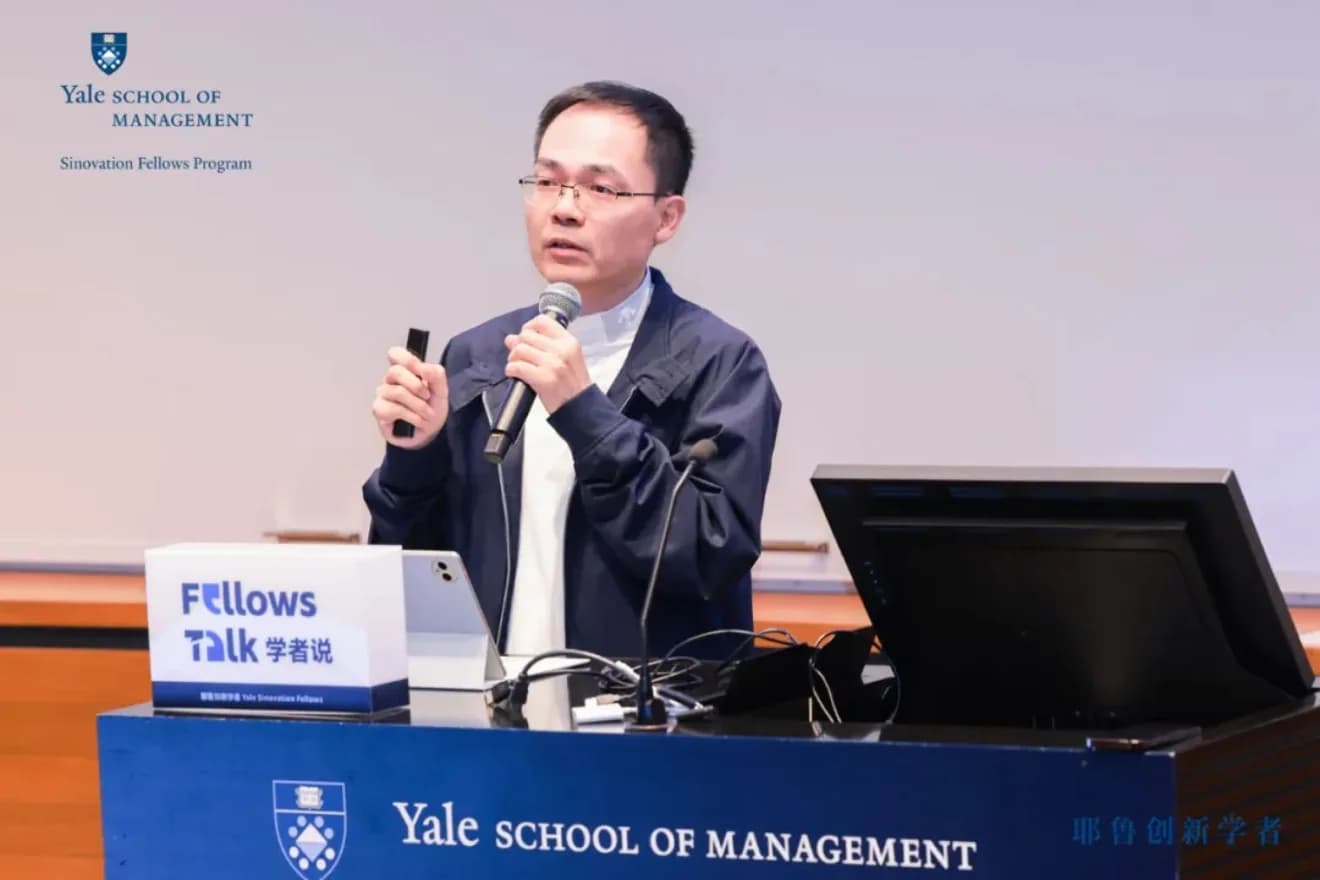
The fifteenth Yale Sinovation Fellows Talk took place at Yale University on September 23, Eastern Time.
Li Shun, a member of the program’s fourth cohort and chairman and CEO of Jiangren Liuyin, spoke on “The Capacity for Individual Growth: From the Personality Equation to the Destiny Equation.” He opened with two enduring questions. Can personality be expressed mathematically? Can destiny be calculated?
He proposed that the personality equation provides a way into both questions. It begins with “How can I become a better version of myself?” and “Where do I come from and where am I going?” From individual growth and inherited endowments, it leads to the question of destiny.
Li described personality as a system that evolves over time. Three forces, connection, exploration and realization, build up against resistance and are accelerated by metacognition. He proposed expressing their accumulation as an integral. He read the traditional saying about fate, luck, feng shui, virtue and study as a progression from factors beyond our control to those we can influence.
The personality equation: A mathematical expression for individual growth
The framework has three origins. First, Li looks at the world through energy and information. Energy conversion efficiency, he argued, shapes a civilization’s capabilities, while the cost of moving information defines its limits. Applying that view to his own business, he concluded that Jiangren Liuyin resembles a company built around information flows more than a conventional drinks company.
Second, he works from first principles. In a Yale course on happiness, psychology professor Laurie Santos asked participants to choose three of 24 personality traits. Li arrived at connection, exploration and realization, concepts absent from the list. They became the driving forces in his equation.
Third, Li said he often makes sense of experiences in hindsight. He calls his ability to reflect on events, identify patterns and apply them again a “recursive engine of compounding.” This talk was also a reflection on what it means to understand things late.
He wrote the equation as Pc(t) = k · eᴹᵗ · ∫₀ᵗ (three forces ÷ resistance) dt.
Pc represents the degree of personality development, k the initial endowment and M the level of metacognition. The numerator is the product of connection, exploration and realization. The denominator is the resistance created by inner conflict and outside pressures.
He described it as a problem of accumulation over time. Once the starting conditions are given, the three forces take shape over the years, accelerated by metacognition and opposed by resistance. Four assumptions underpin the equation. Personality develops until the end of life. The forces multiply, so one approaching zero reduces the whole. Metacognition magnifies those forces exponentially. Resistance is present in every moment of development, like the reverse side of a coin.
Li emphasized that k is a multiplier, a starting parameter that includes inherited temperament, neurological traits and early attachment. Endowments set the starting point and accumulation determines the outcome. Neuroplasticity leaves room for change, though it takes considerable time and effort. Building the three forces and metacognition is a more effective strategy, in his view.
From that perspective, diligence can make up for a lower starting point. Someone with a lower k may need to work harder over a longer period and gain deeper insight through that effort.